The streak ended: the average 30-year fixed mortgage rate rose to 7.28%, its first increase after four straight weekly declines.
That is 0.17 points above last week's 7.11%, though still below the 7.40% plateau that held through mid-October.
The 10-year Treasury yield stayed above 5% from Monday through Thursday, then dropped to 4.92% on Friday.
Locally, Zillow added September's median closed price of $595,000 and October's estimate of 230 closed sales, while listing numbers stay at October's 964 homes for sale.
This Week's Numbers
These are the same numbers every Monday, so you can see the pattern build over time.
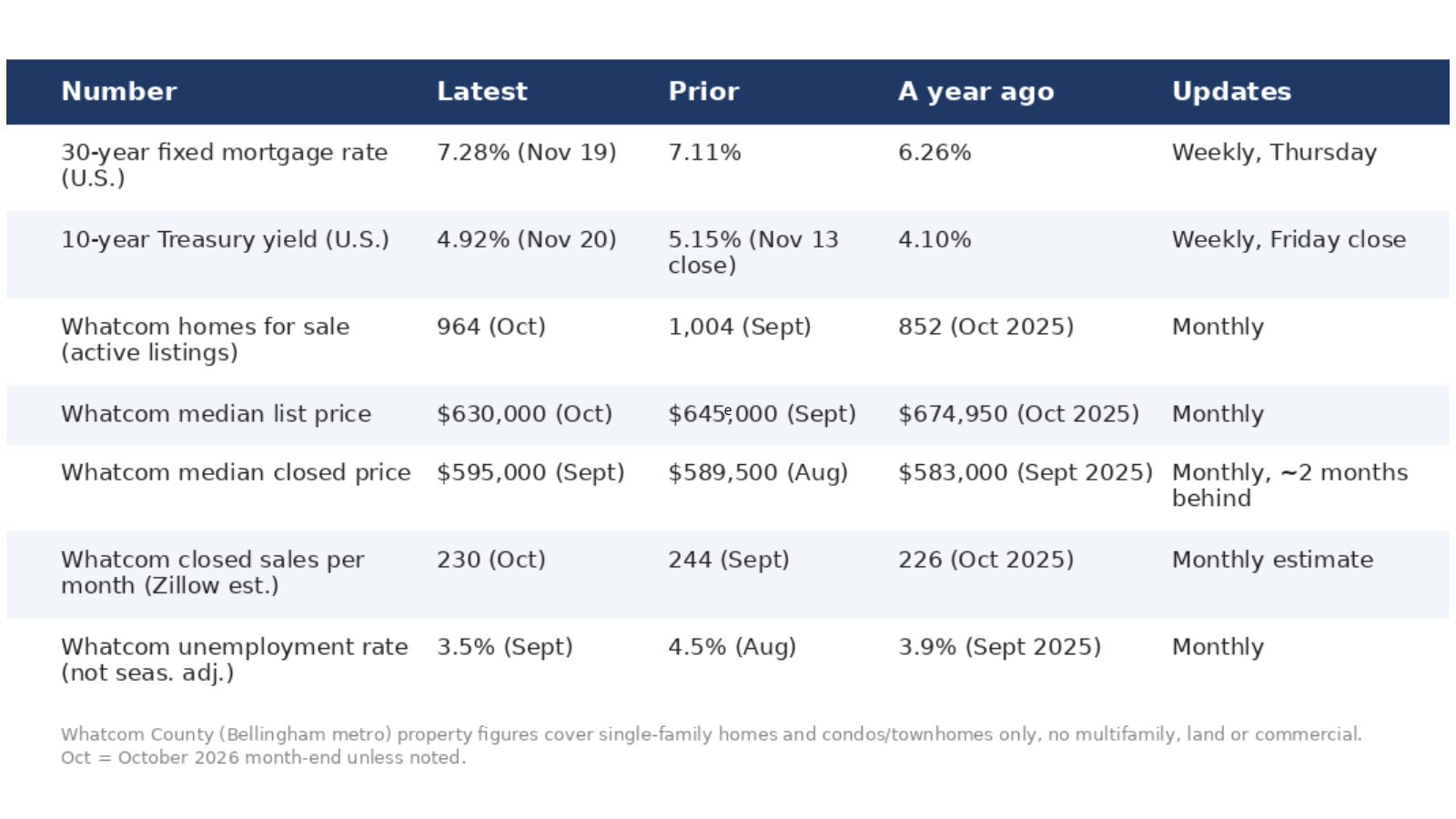
All property numbers cover single-family homes and condos/townhomes only (no multifamily, land or commercial).
Local numbers cover the Bellingham metro area, which is all of Whatcom County.
Listings and list price show what sellers are asking, and the two closed-sale rows show what homes actually sold for, with a lag.
What The Numbers Say
Rates.
Up 0.17 points to 7.28% from 7.11%, the first rise after four straight weekly declines, in a week when the 10-year yield held above 5%.
Yields.
The 10-year yield's weekly average edged up from 5.03% to 5.05%, but Friday's 4.92% close was its lowest since November 9.
Inflation.
There was no new consumer price report this week, so October's 0.4% gain stands, and the October PCE inflation reading is due Wednesday.
Inventory.
No new listings data again: October's 964 active listings, down 4% from September's 1,004, remain the latest reading.
List prices.
The median ask still stands at $630,000, 6.7% below a year ago, with homes taking a median 64 days on market.
Closed sales.
Zillow's new readings show a September median closed price of $595,000, up from August's $589,500 and 2.1% above a year ago, and an estimated 230 closed sales in October versus 226 a year earlier.
How These Numbers Connect To Your Mortgage Rate
Mortgage lenders watch the 10-year Treasury yield when they price most fixed home loans, though it is not the direct benchmark for every loan.
Investors who buy mortgage bonds compare them to Treasuries, so when the 10-year yield moves, mortgage rates follow.
The result is a spread between mortgage rates and the 10-year yield, and that spread moves around over time.
This week that gap widened to about 2.23 points (a 7.28% mortgage rate versus a 5.05% weekly average yield), up from last week's 2.08.
That widening fits last week's timing gap, which I read as mortgage rates catching up to yields that had already climbed.
Over the last ten years that gap has averaged about 2 points, so this week's reading sits a little above the usual range.
What This Means For Buyers
The math gave back a little ground this week, though it is still better than mid-October.
On a $645,000 home with 20% down, the monthly principal and interest payment is about $3,531 at 7.28%, just under $60 more than the $3,471 quote a week ago.
That is still about $42 below the mid-October quote at 7.40%.
At last year's 6.26% the payment would be about $3,180, so the gap to a year ago is roughly $350 a month for the same house.
If you are writing an offer soon, ask more than one lender for a quote, since Freddie Mac's chief economist noted this week that comparing quotes can potentially save thousands over the life of a loan.
A fresh pre-approval shows your budget at today's quotes, and your lender can tell you when a rate lock becomes available, usually after an accepted offer.
What This Means For Sellers
A rate uptick after four weeks of relief is a reminder that buyer momentum can stall quickly.
October's inventory of 964 homes is down from September's 1,004, and the median asking price is 6.7% below a year ago.
Closed prices tell a steadier story, with September's $595,000 median up 2.1% from a year earlier, though Zillow's closed-price figure runs about two months behind.
Well-priced homes still sell, but buyers are negotiating, and the 64-day median time on market says they are taking their time.
If you are thinking about selling before the holidays, price against today's rates and this month's inventory, and expect to negotiate.
What The Fed Is Saying
Freddie Mac's chief economist Sam Khater said Thursday: "While prospective borrowers often shop around for a home, they may not always think to do the same for their mortgage, as comparing multiple rate quotes can potentially save them thousands over a loan's lifetime."
The Fed's October meeting minutes, released Wednesday, showed that almost all participants judged further rate increases would likely be appropriate.
Some participants favored a quarter-point increase in October, and a couple noted that a larger move might be needed in December.
The last meeting ended 10-2 in favor of holding, with the two dissenters wanting to raise rates, and I read the December 8-9 meeting as a live question, not a settled one.
What I'm Watching Next
Tuesday, November 24: Whatcom County's October unemployment reading, expected that day, after September's drop back to 3.5%.
Wednesday, November 25: October's PCE inflation report, and the next mortgage rate reading, released a day early because of Thanksgiving.
December 8-9: the Fed's last meeting of the year, where the hold-versus-hike debate gets decided.
December 10: the November inflation report, out the morning after the Fed's decision.
If you are thinking about a move, schedule a 15-minute call and we can look at your numbers together.
Sources for reader review
Freddie Mac Primary Mortgage Market Survey (weekly 30-year rate) and the November 19 rate release with Sam Khater's comment
U.S. Treasury daily yield curve rates (10-year yield)
Washington Employment Security Department, Whatcom County profile (September unemployment)
Realtor.com Research, Whatcom County market data (listings and list prices)
Zillow Research data (closed sales and closed prices)
Property numbers cover single-family homes and condos/townhomes only.